Maltese care guide
When do Maltese puppies teethe and how do I stop biting?
Milk teeth at three weeks, the big swap from 12 weeks, done by six months. Here is the timeline, why puppies nip, and the kind way to end it.
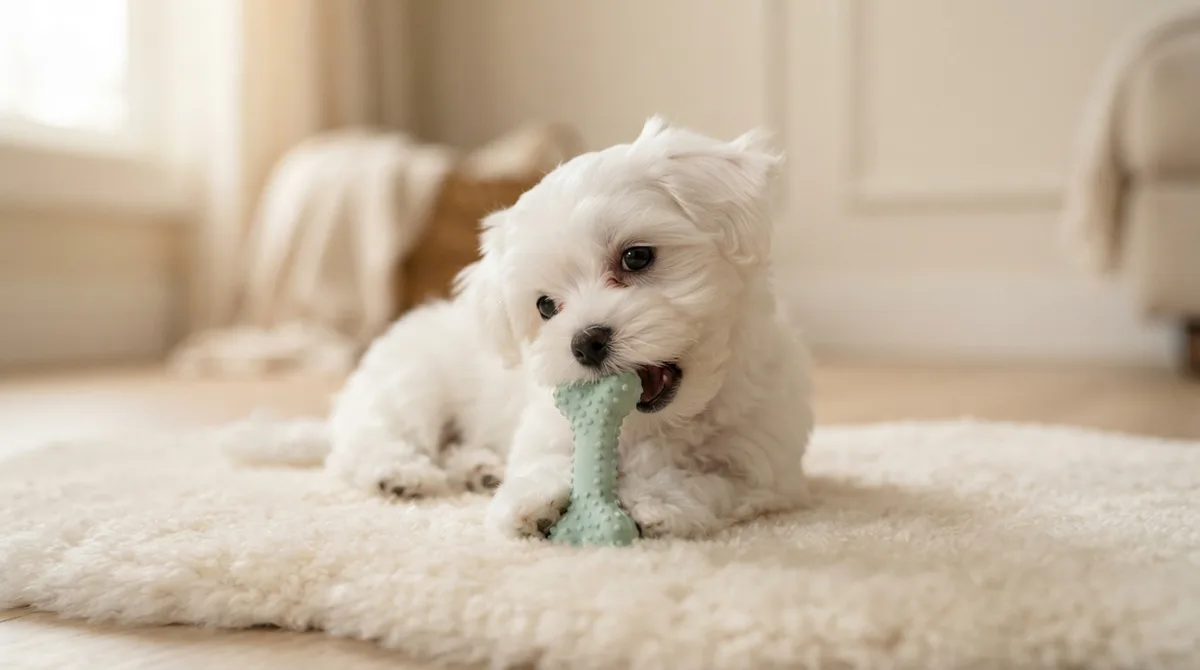
When do Maltese puppies teethe and how do I stop biting?
Maltese puppies cut milk teeth at 3 to 4 weeks, start swapping them for adult teeth from about 12 weeks, and finish around six months. Sore gums plus normal play make them nippy. Teach bite inhibition: yelp and pause when teeth touch skin, redirect onto a size-appropriate chew toy, and never punish. Add enforced naps for evening nipping, and ask your vet to check for retained baby teeth at sterilisation age.
The Maltese teething timeline: what happens when
Teething follows the same broad teething timeline in every dog, and the Maltese is no exception. A puppy is born toothless, cuts its 28 milk teeth (vets call them deciduous or baby teeth) from about three to four weeks, and then, from roughly 12 weeks, starts swapping them for 42 adult teeth. The incisors change first, then the canines and premolars, and finally the molars, so that by around six months most Maltese have their full adult set. The AKC puppy teething timeline is the standard reference if you want the stage-by-stage detail.
What you will actually notice at home: chewing everything, a spot of blood on a chew toy, drooling, occasionally a tiny tooth on the floor (most are swallowed harmlessly), and a puppy that tears up a little more than usual. Teething is even one of the drivers of teething tear stains on that white face. All of it is normal.
Teething in one glance
- 28 milk teeth from 3 to 4 weeks
- Swap starts around 12 weeks
- Full 42 adult teeth by about six months
- Finding a tooth or a little blood is normal
- Nipping now is relief-seeking, not aggression
Why your puppy nips: pain, play or overtired
Not all puppy biting is the same, and matching the fix to the cause is half the battle. First there is teething pain: sore gums drive a physical need to chew, so the puppy gnaws whatever is nearest, including your hands. Second there is play-biting: mouthing is simply how puppies play with their littermates, and yours will try the same game with you until taught otherwise. Neither is aggression; a Maltese is a gentle, people-oriented toy breed, and a nipping ten-week-old is behaving completely normally.
The third cause is the one most guides miss: the overtired puppy. If your sweet Maltese turns into a tiny land shark at 9pm, that "witching hour" frenzy of nipping, zoomies and trouser-tugging is almost always exhaustion, not naughtiness. It needs a nap, not more correction; we cover exactly how below.
Teaching bite inhibition: yelp, pause, redirect
Bite inhibition is a dog's learned control over the pressure of its mouth, and puppyhood is the only cheap time to teach it. The method is simple and works because it mimics what littermates do. The moment teeth touch skin, give a short, sharp yelp ("ow!"), then pause: go still, withdraw your hands and attention for a few seconds so the fun stops instantly. Then redirect: offer a chew toy, and the second your puppy takes it, praise warmly. You are teaching two rules at once: teeth on skin end the game, teeth on toys get a reward.
Two things make or break this training. Consistency: everyone in the household follows the same script every single time, children included. And the golden rule that hands are never toys: no wrestling with your fingers, no waggling hands in the puppy's face, however cute the pouncing is. For the wider obedience picture, from recall to calm greetings, see our full Maltese training guide.
What NOT to do
The mistakes matter as much as the method. Never use punishment: no smacking, no muzzle-grabbing, no shouting. The Maltese is a soft, sensitive breed, and harsh corrections do not teach a soft mouth; they teach fear of hands, which can make nipping worse and handling harder for life. Skip rough games too: wrestling, hand-chasing and wild tug sessions all tell a teething puppy that mouths on people are part of the fun.
Equally, do not just tolerate the biting and wait for it to pass. The teething phase ends on its own; the habit of mouthing people does not. Calm, boring consequences plus a well-timed swap for a chew is the whole trick.
Never do these
- No smacking, shouting or "alpha" corrections
- No wrestling or hand-as-toy games
- No human teething gels (unsafe for dogs)
- No antlers, hooves or very hard chews
- No ignoring it and hoping it stops
Safe chews for a 2-3kg mouth (and the frozen washcloth trick)
Chew advice written for Labradors can hurt a Maltese. A full-grown Maltese weighs 2 to 4kg, and a teething puppy has a genuinely small mouth and a tiny jaw, so both size and texture matter. Pick puppy-sized rubber chews and a small puppy Kong: big enough that it cannot be swallowed, soft enough to dent with a thumbnail. Rotate two or three so they stay interesting, keep one within arm's reach in every room you use, and supervise anything your puppy chews.
Cold soothes sore gums beautifully. The cheapest tool is the frozen washcloth trick: wet one corner of a clean washcloth, wring it out, twist it and freeze it, then let your puppy gnaw the icy fabric while you hold the dry end. A chilled (not rock-hard frozen) rubber toy works the same way. Avoid antlers, hooves and hard nylon bones sized for bigger dogs; they can crack those small teeth. And skip human teething products entirely; some contain ingredients that are unsafe for dogs.
Retained baby teeth: the toy-breed catch nobody warns you about
Here is the part generic teething guides skip, and it matters most for a Maltese. In toy breeds, some milk teeth, most often the upper canines, never fall out even as the adult tooth erupts beside them. The result is retained baby teeth: a double row of teeth, often called double canines, in an already crowded little mouth. Trapped food and plaque between the two rows becomes a tartar trap, and the misplaced adult tooth can shift the bite. The VCA veterinary guide to retained baby teeth explains why small breeds are the classic case.
The fix is routine when caught early. Ask your vet to check the mouth at every visit from four months on, and specifically around sterilisation age (spay or neuter, commonly around six months in Singapore): any retained teeth are usually extracted under that same anaesthesia, so your puppy needs no extra procedure.
The overtired biter: naps fix what training cannot
A young puppy needs around 18 to 20 hours of sleep a day, and a Maltese puppy in an exciting new home rarely takes them unprompted. Skip the sleep and you get the evening frenzy: frantic nipping that no amount of redirection seems to touch. The fix is a nap schedule, not more discipline. Roughly every hour of awake time earns a rest; when the biting turns wild-eyed and relentless, calmly pop your puppy into its playpen or crate with a safe chew, and most "biting problems" evaporate mid-protest into sleep.
Enforced quiet time is not unkind; it is what an overtired baby animal needs and cannot choose for itself. Build naps into the daily rhythm from day one. Our first week home guide lays out a settling-in routine, with sleep at the centre of it.
Start dental care during teething, not after
Teething is the perfect moment to build the habit that protects your dog for life. Small breeds are notoriously prone to dental disease, and the Maltese's crowded mouth makes daily care non-negotiable in adulthood. Start now, gently: a soft finger brush or gauze with dog-safe enzymatic toothpaste, a few seconds a day, always paired with praise. During sore-gum weeks keep it light; the goal is a puppy that welcomes tooth brushing, not perfect plaque control at four months.
Sore gums can also cause a brief appetite dip. Softening kibble with warm water for a few days helps; our feeding guide covers what and how much to feed. For why dental health is one of the biggest levers on a Maltese's long lifespan, see the dental section of our health and lifespan guide.
How we set new owners up for the teething months
Our puppies go home at around nine weeks, which means the whole milk-to-adult swap happens on your watch, and we plan for that. Curious Tails is an AVS licensed shop in Singapore, every puppy leaves vaccinated, microchipped and vet health checked, and at handover we walk you through the teething playbook in person: the yelp-pause-redirect routine, which chew sizes suit a 2 to 3kg mouth, and the retained-teeth check to request at sterilisation.
And the reassuring truth from the 50-plus Maltese we have placed: the shark phase ends. Stay consistent through those few months and the teething puppy grows into exactly what the breed promises, a gentle, calm companion with a soft mouth. WhatsApp us any time mid-teething; the coaching does not stop at the door.
Frequently asked questions
When do Maltese puppies stop teething?
Usually by about six months, once all 42 adult teeth are in. The heaviest chewing runs from roughly 12 to 16 weeks, when milk teeth start falling out, until the molars settle.
How do I stop my Maltese puppy biting me?
The moment teeth touch skin, give a short yelp, pause the game and go still, then redirect onto a chew toy and praise the switch. Whole-family consistency ends it; punishment does not.
Is my Maltese puppy’s biting aggression?
Almost never. Nipping in a young puppy is teething pain, normal play-biting or overtiredness, not aggression. The Maltese is a gentle breed; calm redirection is all it needs.
Why is my puppy so bitey at night?
The evening "witching hour" is usually an overtired puppy. Puppies need around 18 to 20 hours of sleep a day; an enforced nap in the playpen fixes most 9pm land-shark behaviour.
What can I give my teething Maltese to chew?
Small, softish rubber puppy chews and a puppy Kong sized for a 2-3kg mouth, plus the frozen washcloth trick: freeze a damp washcloth and let the puppy gnaw the cold fabric under supervision.
I found a tooth on the floor. Is that normal?
Completely. Milk teeth fall out from about 12 to 16 weeks and many are swallowed harmlessly, so a found tooth or a spot of blood on a chew toy is a milestone, not an emergency.
What are retained baby teeth in a Maltese?
Baby teeth, often the upper canines, that never fall out, leaving a double row. Toy breeds are the classic case. Have your vet check at sterilisation age; retained teeth are usually extracted under the same anaesthesia.
My teething puppy is eating less. Should I worry?
A small appetite dip with sore gums is common. Soften kibble with warm water for a few days and offer cool chews. If your puppy refuses food outright or seems unwell, call your vet.
Related guides


Meet your Maltese
Come say hello at Balestier
2 Balestier Road #01-701, Singapore 320002 · Weekdays 12pm–6pm · Weekends 10am–6pm. Or message us first: tell us about your home and routine, and we'll tell you honestly if a Maltese fits.