Maltese care guide
What is the best food for a Maltese?
Forget brand lists. Here are the criteria that make a food right for a 2 to 4kg dog, real feeding amounts by age, the puppy rules that keep blood sugar safe, and the honest link between diet and tear stains.
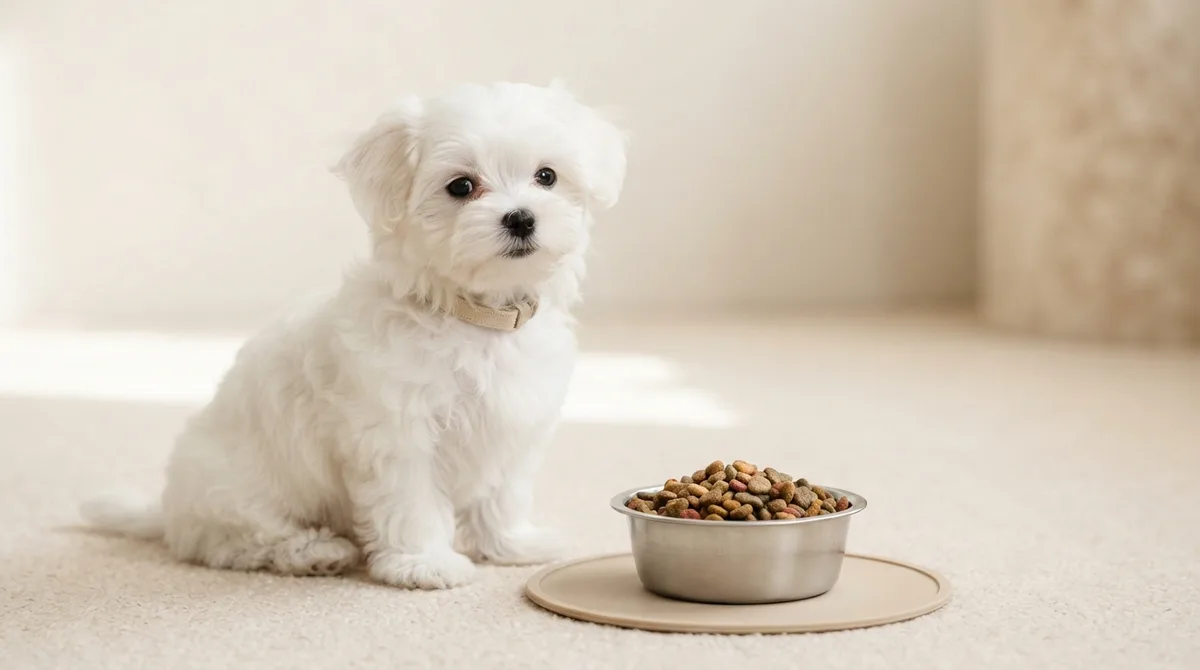
What is the best food for a Maltese?
A complete small-breed food with a named animal protein first, omega fatty acids for the coat, and no fillers or artificial colours. Feed a 2 to 4kg adult roughly 45 to 80 grams of dry food a day over two meals, and a puppy three to four small meals a day. Check your packaging guide and vet, and change foods over 7 days.
What "best food" actually means for a 2 to 4kg dog
Skip the brand lists. The best food for a Maltese is not one magic bag; it is any recipe that meets a short set of criteria you can read off a label. Start with the format: a small breed or toy-breed kibble. The bite size matters because a Maltese jaw is genuinely tiny, and standard kibble is hard to chew, so small pieces get eaten instead of dropped. The calorie density matters because a small dog has a fast metabolism but a thimble-sized stomach: small-breed formulas pack more energy per gram, so a physically small portion still covers the day.
On the ingredient panel, look for a named animal protein (chicken, salmon, lamb) as the first ingredient, plus omega 3 and 6 fatty acids and vitamin E, which show up directly in the condition of the white coat. Avoid recipes padded with cheap fillers like corn, soy and vague "meat meal", and skip anything with artificial colours; dyes exist to please owners, not dogs. Any quality diet that ticks these boxes will suit most Maltese, whether it costs a little or a lot.
The label checklist
- Small-breed kibble sized for a toy jaw
- Named animal protein as the first ingredient
- Omega fatty acids and vitamin E for the coat
- No corn/soy fillers or artificial colours
- Complete and balanced for the life stage (puppy or adult)
How much to feed, by age and weight
This is the question overseas guides dodge, so here it is for the real Maltese weight band of 2 to 4kg. Treat the table below as a rule of thumb only: brands vary widely in calories per gram, so always cross-check the packaging guide for your specific food and confirm with your vet, especially for a growing puppy. The AKC feeding guidance makes the same point: charts start the conversation, body condition finishes it.
Measure meals with a scale or measuring cup rather than free-feeding, and count treats inside the daily total; keep them under about 10 percent of calories. A few extra grams a day is trivial for a Labrador and significant for a 2.5kg lapdog, which is how small dogs quietly become overweight. The test is simple: you should feel ribs under a light layer and see a waist from above. Lean is not skinny; lean is healthy.
| Life stage | Typical weight | Dry food per day (approx.) | Meals a day |
|---|---|---|---|
| Puppy, 2 to 4 months | 0.7 to 1.5kg | 40 to 60g of puppy formula | 4 |
| Puppy, 4 to 6 months | 1.2 to 2.5kg | 45 to 70g of puppy formula | 3 |
| Junior, 6 to 12 months | 2 to 3.5kg | 45 to 75g, transitioning to adult food | 2 to 3 |
| Adult, 2 to 3kg | 2 to 3kg | 45 to 65g | 2 |
| Adult, 3 to 4kg | 3 to 4kg | 60 to 80g | 2 |
| Senior, 8+ years | 2 to 4kg | Often 10 to 20% less; vet-guided | 2 |
Puppy meal frequency and the low blood sugar risk
Frequency matters as much as amount. A young Maltese puppy needs three to four meals a day, spaced through the day, moving to three around four months and settling at two meals a day from about six months into adulthood. The reason is not fussiness. Toy-breed puppies carry almost no energy reserve, so a skipped meal can tip them into hypoglycaemia, a sudden drop in low blood sugar territory that is a genuine emergency in a 1kg body.
Keep the schedule boring and predictable, and never fast a toy puppy for convenience. If a meal is refused, offer it again within the hour and watch closely; a puppy that skips food and seems flat is not being dramatic, it is at risk.
Switching food: the 7-day rule, and how we handle handover
A Maltese has a small, sensitive gut, so any diet change should be a slow transition over about 7 days: roughly 25 percent new food for days one and two, 50 percent for days three and four, 75 percent for days five and six, then fully switched. Rushing it is the classic cause of an upset stomach, loose stool or vomiting in the first week with a new food.
This is also how we work at Curious Tails, our AVS licensed shop. Every puppy goes home with a supply of the exact food it has been eating and a written feeding plan, because moving house is stressful enough without a gut change on top. Keep the same food for at least the first week home, let your puppy settle, then run the 7-day switch if you want a different brand later. Continuity first, preference second.
The tear-stain diet angle, honestly
Food forums are full of owners who switched brands and watched tear stains fade, and others who switched five times for nothing. The honest position: diet is one lever, not the cause. Stains come from porphyrin pigments in tears; what you feed can influence them at the margins. Filler and dye-heavy foods are the first thing worth eliminating, and a plastic bowl, which scratches and harbours bacteria against the chin, is worth swapping for a stainless steel bowl washed daily. Some owners also see improvement offering filtered water.
Run any change as a supervised trial of several weeks, one variable at a time, and keep the daily face-cleaning habit going regardless; no food replaces it. For the full picture of causes and the routine that actually works, see our complete tear-stain guide.
Toxic foods: a small body means a small dangerous dose
Every dog owner should know the toxic foods list, but for a toy breed the stakes are multiplied, because dose scales with body weight. The square of dark chocolate a Beagle shrugs off can be a serious dose for a 2.5kg Maltese. The big four: grapes and raisins (kidney failure, no known safe amount), xylitol (a sweetener in sugar-free gum, sweets and some peanut butters that crashes blood sugar and injures the liver), chocolate, and the onion and garlic family, including onions hidden in cooked human food and gravies. The ASPCA poison control list covers the rest.
In an HDB flat or condo, the practical risk is scraps: food dropped at the table, a raided bin, a child sharing snacks. If your Maltese eats any of these, call a vet immediately with the amount and time; with a body this small, do not wait to see what happens.
Never feed a Maltese
- Grapes, raisins and sultanas
- Xylitol (sugar-free gum, sweets, some peanut butters)
- Chocolate, especially dark, and coffee
- Onions, garlic, leeks and chives
- Macadamia nuts, alcohol and cooked bones
Fresh food and home-cooked meals, honestly
Plenty of Singapore owners want to cook, and fresh food has real appeal for a picky eater. The honest caveat: a home-cooked diet is only safe long-term if the recipe is actually balanced, and studies of improvised recipes keep finding gaps in calcium, vitamins and trace minerals that show up slowly, in the bones, skin and coat. Chicken and rice is a recovery meal, not a diet.
If you want to cook, do it with veterinary nutrition guidance, ideally a recipe formulated by a board-certified veterinary nutritionist, in line with the WSAVA global nutrition guidelines. A safer middle ground for most homes: a complete commercial food as the base, with a spoon of fresh topper for interest.
Winning over a picky eater
Maltese have a reputation as fussy, and it is usually trained fussiness: a dog that learns refusing dinner produces something tastier will keep refusing. The fix is calm structure. Put the meal down for about 15 minutes, then lift it without comment and offer nothing until the next scheduled mealtime; a healthy adult will not starve itself. Warming wet food slightly, or adding a little warm water to kibble, lifts the aroma and often does more than another brand change. What kills appetite most reliably is a full treat jar, so cut treats before blaming the food.
The one exception matters: sudden appetite loss in a dog that normally eats well is a health signal, not a mood. In a toy breed, two missed meals earns a vet call, and in an older Maltese, going off food can point at dental pain, which is extremely common in small dogs.
Water and hydration in the Singapore heat
Feeding advice written for temperate countries misses this: in Singapore, a Maltese lives in 30-degree heat and high humidity year-round, and a small dog dehydrates faster than a big one. Fresh water should be available in more than one spot, washed and refilled daily, and topped up before and after walks. Dogs on a dry-kibble diet drink noticeably more than wet-fed dogs, so watch the bowl, not the calendar.
Good hydration also supports eye and skin health in a breed prone to staining. For walk timing, cooling and the signs of overheating in a small white dog, see our hot-weather care guide.
Diet and the long game
A Maltese routinely lives 12 to 15 years, and what fills the bowl is one of the few levers you fully control. Lean-fed dogs live measurably longer than overweight ones, carry less strain on small joints and, crucially for this breed, less strain on the heart; mitral valve disease is the leading cause of death in older Maltese, and excess weight makes a failing heart work harder. Keeping an adult Maltese lean is not cosmetic, it is cardiac care.
Pair good feeding with daily tooth brushing, since dental disease is near-universal in toy breeds, and keep up the annual vet check where weight and diet get reviewed. For the full health picture, from vaccinations to the senior years, read our lifespan and health guide. And if you are still choosing your puppy, ask us on WhatsApp exactly what our available puppies are eating; we will tell you the brand, the grams and the schedule, in writing.
Frequently asked questions
How much should I feed a Maltese?
Roughly 45 to 80 grams of dry food a day for a 2 to 4kg adult, split into two meals. Treat that as a rule of thumb: check your food’s packaging guide for its calorie density and confirm with your vet, then adjust to keep a visible waist.
How often should I feed a Maltese puppy?
Three to four meals a day until about six months, then move gradually to two meals a day. Toy-breed puppies should never skip meals because of hypoglycaemia risk.
What should I look for in Maltese food?
Small-breed kibble with a named animal protein first, omega fatty acids and vitamin E for the white coat, and no cheap fillers or artificial colours. Criteria beat brand names.
Does food cause tear stains in Maltese?
Diet is one lever, not the cause. Filler and dye-heavy foods, plastic bowls and mineral-heavy water are worth swapping out in a supervised trial, alongside daily face cleaning.
What foods are toxic to a Maltese?
Grapes and raisins, xylitol in sugar-free products, chocolate, and onion and garlic top the list. A 3kg body means a tiny amount can be a dangerous dose, so call a vet immediately after any exposure.
Is home-cooked food good for a Maltese?
Only if the recipe is formulated with veterinary nutrition guidance. Most improvised home-cooked diets are unbalanced over time; a safer middle ground is a complete food with fresh toppers.
My Maltese is a picky eater. What should I do?
Offer the meal for about 15 minutes, then lift the bowl and try again at the next mealtime. Warming the food helps; rotating through new foods teaches holding out. Sudden appetite loss is a vet question.
Should I feed wet or dry food?
Either quality option works, and mixed feeding is fine. Small dry kibble gives a mild dental benefit; wet food adds water. Portion control matters more than format.
Related guides



Meet your Maltese
Come say hello at Balestier
2 Balestier Road #01-701, Singapore 320002 · Weekdays 12pm–6pm · Weekends 10am–6pm. Or message us first: tell us about your home and routine, and we'll tell you honestly if a Maltese fits.