Maltese care guide
How do I potty train a Maltese?
Small dog, tiny bladder, honest timeline. The pee-tray, schedule and reward system that actually works in a Singapore flat.
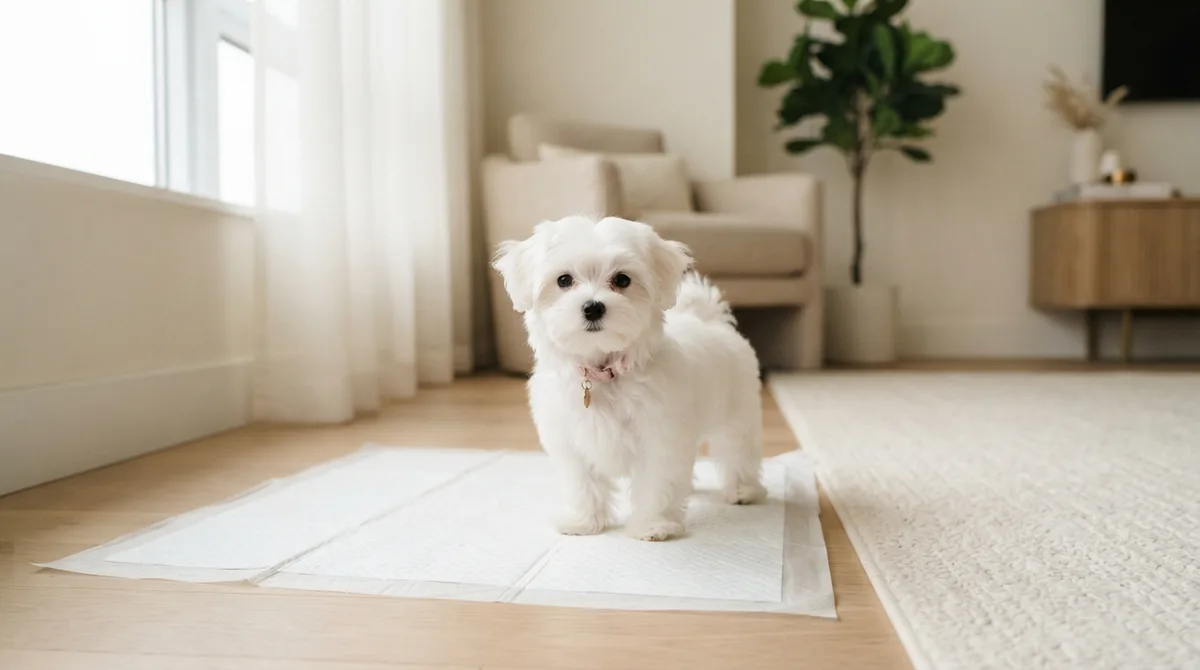
How do I potty train a Maltese?
Pick one method first (pee tray, outdoor, or hybrid, and a tray suits HDB flats best), set up a playpen with the tray far from the bed, and take your Maltese to the tray after every sleep, meal and play session. Reward within three seconds of finishing, never punish accidents, and clean misses with an enzymatic cleaner, never ammonia. Expect months, not weeks: a toy breed counts as trained only after two to four weeks fully accident-free.
The honest starting point: toy breeds take longer
Potty training a Maltese takes months, not weeks. A toy breed of 2 to 4 kg has a genuinely tiny bladder, so a puppy physically cannot hold on the way a Labrador can, and its accidents are so small that a puddle behind the sofa can go unnoticed for days. Every unnoticed accident is a rehearsal of the wrong habit.
None of this means the Maltese is slow. It is a smart, people-focused companion that learns house training (or toilet training, same job) the way every dog does: through supervision, a strict schedule and instant reward. The difference is margin for error: big dogs forgive sloppy timing, a Maltese does not. Our full Maltese training guide covers obedience; this page is purely the toilet, done properly for a Singapore home.
Pee tray, outdoor, or hybrid: pick your method first
Most potty guides online assume a landed house with a garden. In an HDB flat (where the Maltese is approved as item 33 on the small-breed list) your real choice is a pee tray or pee pads indoors, outdoor toileting on leash walks, or a hybrid of both. Decide before day one, because switching methods mid-training confuses the dog and restarts the clock.
| Method | Pros | Cons | Best for |
|---|---|---|---|
| Indoor pee tray or pads | Always available; rain-proof; suits a tiny bladder; fine for life at this size | Tray hygiene is on you; some dogs chew pads; needs one fixed spot | HDB and condo flats, long work hours, older owners |
| Outdoor only | No tray at home; toileting pairs with exercise; cleanest flat | Lift trips at every urge; rain and monsoon refusal; hard for a young puppy's frequency | Ground-floor homes, retirees home all day |
| Hybrid (tray + outdoors) | Backup for rain, illness and late nights; most flexible for life | Slightly slower to train; you must reward both spots deliberately | Most Singapore Maltese owners, and what we recommend |
The pen + tray setup that prevents mistakes
Toilet habits are built by architecture, not willpower. Set up a playpen with the bed and water bowl at one end and the pee tray at the opposite end, as far apart as the pen allows. Dogs have a den instinct and avoid soiling where they sleep, so the layout itself steers the puppy onto the tray. A crate can sit inside the pen as the bedroom; the pen floor in between is the play zone.
Keep the tray in one fixed spot from day one, typically the service yard, a bathroom corner or a ventilated balcony; residual scent tells the puppy "this is the toilet", and moving the tray around is the most common self-inflicted setback we see. An artificial grass tray makes a later jump to outdoor toileting easier. Freedom is earned: start with the pen plus one room under confinement, and expand only as clean weeks stack up. Our first week home guide shows the arrival-day version of this setup.
Schedule by age: the bladder-hold rule of thumb
The working rule of thumb, echoed in AKC house-training guidance, is that a puppy can hold its bladder for roughly its age in months plus one, in hours, during the day. An 8-week-old Maltese manages barely two hours; a 12-week-old about three. For a toy breed, treat those numbers as the ceiling, not the plan, and take the puppy to the tray well before the limit.
Tray trips by age (rule of thumb)
- 8 to 10 weeks: every 1.5 to 2 hours, plus after every sleep, meal and play session
- 3 to 4 months: every 2 to 3 hours, plus the same triggers
- 5 to 6 months: every 3 to 4 hours; signals become reliable
- Adult Maltese: comfortable 4 to 6 hour spacing, first thing in the morning and last thing at night fixed
- Always: one trip immediately after waking, within 15 minutes of eating, and after excited play
Catch and carry: the small-dog advantage
Here is where a 2 kg dog beats a 30 kg one: you can pick it up. The catch and carry technique is simple. Watch for pre-toilet signals: sniffing the floor in tight circling patterns, sudden restlessness, drifting toward a previously soiled corner or heading behind furniture. The moment you see them, calmly scoop the puppy up and place it on the tray, then wait quietly.
If you catch an accident mid-stream, interrupt with a soft "ah-ah", carry to the tray, and reward whatever finishes there. No shouting, no drama. A startled puppy stops mid-flow and finishes on the tray often enough that this single habit shortens training by weeks.
Reward timing: the three-second window
Dogs connect a reward to whatever happened in the last few seconds, nothing earlier. So the treat and praise must land within about three seconds of the puppy finishing on the tray, delivered at the tray, not back in the kitchen. Walk away to fetch a treat and you have rewarded "walking to the kitchen", not "toileting on the tray". Keep a sealed jar of treats next to the toilet spot so the timing is physically possible.
Once your Maltese toilets promptly on the tray, add a cue word ("toilet") said quietly as it starts, rewarded as it finishes. Within weeks you have toileting on cue, which is gold before car rides and grooming trips.
Accidents: clean right or train forever
Every accident spot that still smells of urine is a signpost saying "toilet here". Dog noses detect traces long after soap declares the floor clean, so use an enzymatic cleaner (sold at any Singapore pet store) that biologically breaks down the odour compounds rather than masking them. Blot first, soak the area, let it air dry.
Never clean with ammonia or ammonia-based household cleaners. Urine itself contains ammonia, so to a dog the "cleaned" patch smells like a well-used toilet and invites a repeat. And never punish the dog: scolding after the fact teaches only that you are dangerous around puddles, which produces a Maltese that hides to pee behind the curtains. Clean calmly, tighten supervision, and shorten the gap between tray trips for a few days.
Regression: why a trained Maltese starts missing
Almost every owner hits a phase where a reliable dog suddenly is not. Work through causes in order, and remember that sudden accidents in a previously clean adult deserve a vet check first, since a urinary tract infection is a classic hidden cause; VCA veterinary guidance covers the medical rule-outs.
Common regression causes, in checking order
- Medical: urinary tract infection, tummy upset, or age-related changes. Vet first when the change is sudden.
- Routine change: a house move, renovation, new baby, new work hours or a moved tray. Rebuild the old schedule for two weeks.
- Adolescent marking: intact males from around 6 to 12 months lift a leg on furniture. This is marking, not failed training; management plus neutering (discuss timing with your vet) usually resolves it.
- Rain refusal: outdoor-trained dogs in Singapore's wet season simply hold on rather than step into a downpour, then burst indoors. Keep a tray as a backup.
- Anxiety: a velcro breed left alone too long may toilet from stress; see our separation anxiety guide.
The night routine
At night, run a fixed shutdown: last meal at least three hours before bed, lift the water bowl about an hour before, one final tray trip at lights out. A puppy under four months will likely need one midnight break for the first few weeks; keep it boring, lights low, onto the tray, quiet praise, straight back to bed. No play, or you will be booking a 3am party nightly.
Sleeping the crate or pen near your room lets you hear the whining that signals a genuine need. If whining continues after the bladder is clearly empty, that is attachment, not toileting; our separation anxiety guide takes over from there. Most puppies sleep through by four to five months.
When is a Maltese actually trained? The 2 to 4 week rule
Here is the honesty most guides skip: your Maltese is potty trained when it has been completely accident-free for two to four weeks with normal freedom of the home, not when it had one good week. Owners who relax after a few clean days, drop the routine and open every door are the ones back at square one a month later. Keep the schedule, the rewards and the fixed toilet spot running until the clean streak is genuinely long, then fade the treats gradually while keeping the praise.
This honest timeline is exactly what we coach at handover. Curious Tails is an AVS licensed shop that has placed 50+ Maltese into Singapore homes, most of them HDB flats, and every family leaves with the pen layout, the age-based schedule and the consistency rules on paper. Ready for the real thing? Meet our Maltese puppies, vaccinated, microchipped and home from around week nine, with the toilet plan set up before the puppy walks in the door.
Frequently asked questions
How long does it take to potty train a Maltese?
Plan in months, not weeks. Toy breeds have tiny bladders and their small accidents are easy to miss, so most Maltese need two to four months of consistent work before they are reliably accident-free.
Should I train my Maltese to a pee tray or outdoors?
In an HDB flat, a fixed indoor pee tray is the most practical base, and many owners add outdoor toileting on walks later. A hybrid gives you a rainy-day and late-night option for life.
Can a Maltese use a pee tray forever?
Yes. A 2 to 4 kg dog produces very little waste, and lifelong indoor tray use is common and hygienic in Singapore flats if you wash the tray or change pads daily.
Why does my trained Maltese suddenly have accidents?
Check three things: a routine change or house move, adolescent marking in intact males, and medical causes. Sudden accidents in a previously reliable dog deserve a vet check first to rule out a urinary tract infection.
Should I punish potty accidents?
No. Punishment teaches a Maltese to hide where it goes, behind sofas and under beds, which makes training far harder. Clean up calmly with an enzymatic cleaner and tighten supervision instead.
What do I do at night with a young puppy?
Last tray trip at lights out, lift the water bowl about an hour before bed, and expect one midnight toilet break for the first few weeks. Most puppies sleep through by four to five months.
Why does my Maltese refuse to toilet in the rain?
Rain refusal is common in outdoor-trained small dogs in Singapore's wet season. Keep an indoor pee tray as a backup so a downpour never forces your dog to hold on for hours.
When can I say my Maltese is fully potty trained?
Only after two to four weeks completely accident-free with normal freedom of the home. One clean week is progress, not graduation, so keep the schedule going until the streak is long.
Related guides

Meet your Maltese
Come say hello at Balestier
2 Balestier Road #01-701, Singapore 320002 · Weekdays 12pm–6pm · Weekends 10am–6pm. Or message us first: tell us about your home and routine, and we'll tell you honestly if a Maltese fits.