Breed comparison
Maltese vs Bichon Frise
Two small white companions people mix up constantly, with two completely different coats underneath. Here is the honest side-by-side: how to tell them apart, what each coat really demands, and which suits a Singapore home.
Nelson and Kim, Curious Tails · AVS licence AS24J00046
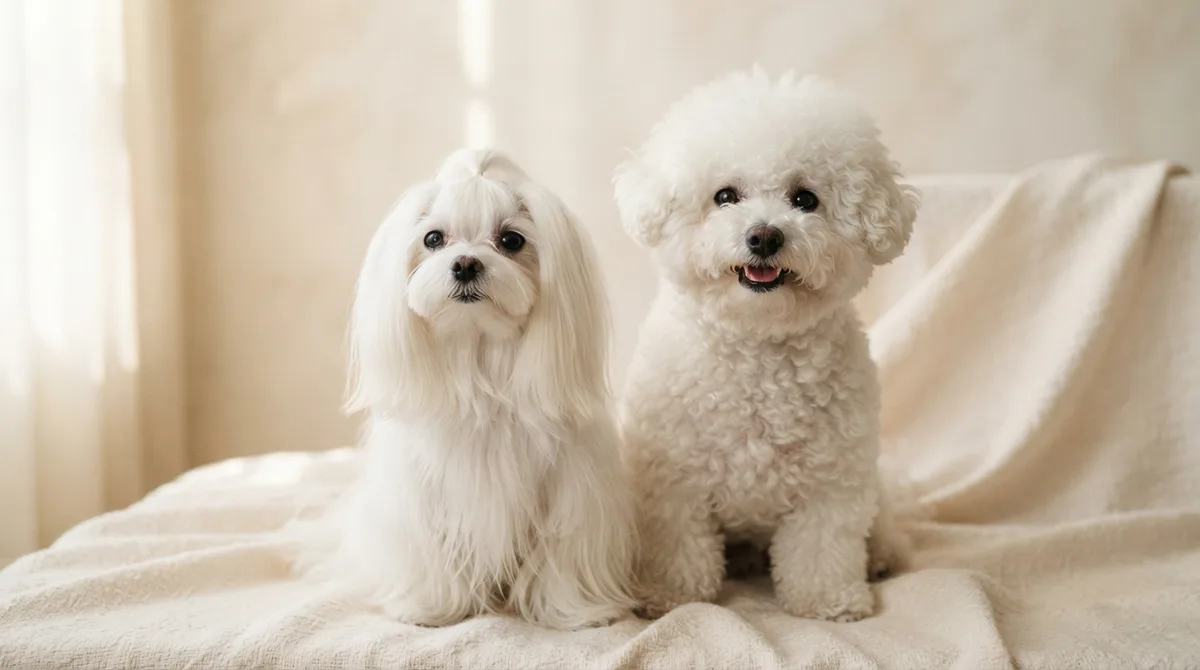
What is the difference between a Maltese and a Bichon Frise?
The Maltese is a 2-4kg toy with a long, straight, silky single coat and a gentle, velcro temperament. The Bichon Frise is a sturdier 5-8kg dog with a curly, powder-puff double coat and a bouncier, more sociable personality that needs professional clipping every 4-6 weeks. Both are white, low-shed and HDB-approved.
Maltese vs Bichon Frise at a glance
Ask ten people at a Singapore dog run and half will mix these two up. Both are small, white, low-shedding companion breeds with centuries of history as beloved lapdog types, and from across a park they can blur into one fluffy shape. Up close, the difference is unmistakable: the Maltese wears a long, straight, silky single coat that hangs like hair, while the Bichon Frise wears a curly, plush double coat that stands out from the body in the famous powder-puff shape.
The coat is only the start. The Bichon is a sturdier dog at roughly 5-8kg, with a bit more bounce and clownish humour; the Maltese is a finer 2-4kg toy with a softer, more devoted velcro nature. Here is the whole comparison in one table, then the detail behind each row.
| Maltese | Bichon Frise | |
|---|---|---|
| Coat | Straight, silky, single coat (no undercoat) | Curly, plush double coat with soft undercoat |
| Colour | Pure white | White, sometimes cream or apricot shadings |
| Size | 2-4kg, about 20-25cm | 5-8kg, about 23-30cm |
| Build | Fine-boned, delicate | Sturdier, more robust |
| Energy | Lower-energy, calm indoors | Medium; playful, clownish bursts |
| Temperament | Gentle, affectionate, velcro | Cheerful, sociable, outgoing |
| Grooming | Daily brushing; tear-stain routine | Daily brushing; clipping every 4-6 weeks |
| Shedding | Very low | Very low (hair caught in curls) |
| Lifespan | 12-15 years | 14-15 years |
| HDB | Approved, named item 33 | Approved small breed |
| Best for | Calm, present homes; first-time owners | Lively, social, active homes |
How to tell them apart at a glance
Because both breeds are often kept in a short pet trim locally, even the coat clue can be subtle, so here is the field guide we use when families ask us to tell them apart. Start with texture: run your eye along the back. Maltese hair lies flat and catches the light with a silk-like sheen, even when cut short; Bichon coat springs back like a sponge and has a matte, cotton-ball look. Next, the build: the Bichon is visibly bigger, rounder and sturdier, while the Maltese is smaller, fine-boned and lighter on its feet.
Then the face. The Bichon's head is scissored into a rounded halo with dark eyes set in a broad skull; the Maltese face is more refined, often with a topknot, and because its facial hair is straight and silky, tear stains show far more sharply on it (our tear-stain guide covers why). Finally the tail: both carry a plumed tail over the back, but the Maltese plume drapes into the coat while the Bichon's sits on that distinctive pom-pom rear.
Spot the difference in five seconds
- Coat: straight and shiny = Maltese; springy curls = Bichon
- Size: noticeably bigger and rounder = Bichon
- Face: refined with visible tear staining = Maltese; rounded halo = Bichon
- Movement: bouncy and clownish = Bichon; light and gliding = Maltese
- Colour: pure white only = Maltese; white with possible cream = Bichon
The coat: single silky vs curly double
This is the deepest structural difference between the two, and it drives almost everything else. The Maltese breed standard calls for a single-layer, straight, silky coat with no undercoat: it grows long like human hair, hangs flat, and can reach the floor in show trim. The AKC Bichon Frise standard describes the opposite architecture: a soft, dense undercoat beneath a coarser, curly outer coat, which is what gives the breed its plush, spring-loaded feel.
The practical consequences are real. The Maltese single coat sheds very little but tangles at skin level, so matting prevention is about a thorough daily brushing down to the skin, not just over the top. The Bichon double coat traps its own dead hair inside the curls, which keeps loose hair off your sofa but means that trapped hair mats fast if brushing lapses, and the coat cannot simply grow out neatly: it must be professionally clipped and scissored to keep its shape. Neither coat is the easy one. They are two different jobs, not a harder and an easier version of the same job.
Grooming cadence and cost: brushing vs clipping
Overseas comparisons wave at "both need lots of grooming" and move on. Here is the actual cadence, because it shapes your weekly routine and your monthly budget. Both breeds need brushing at home most days. The Maltese adds a two-minute eye-wipe for tear stains, morning and night. The Bichon adds a non-negotiable professional appointment: its curls must be clipped every 4-6 weeks to hold the teddy-bear shape, and a skilled groomer in Singapore typically charges more for the Bichon's scissor-heavy trim than for a Maltese puppy cut.
Most Singapore Maltese owners also book a salon session every four to six weeks for a practical puppy cut, so the visit rhythm ends up similar; the difference is that a Maltese in a longer trim can stretch appointments if home brushing is diligent, while a Bichon cannot skip the clipper without losing the coat's shape. Budget realistically for either: salon visits, a slicker brush and comb at home, and for the Maltese a whitening-safe shampoo. Our full grooming guide breaks down the Maltese side in detail, and the American Maltese Association is the reference for the long show coat if you are curious what full-length maintenance involves.
| Task | Maltese | Bichon Frise |
|---|---|---|
| Brushing at home | Daily, down to the skin | Daily, curls to the skin |
| Face and eye care | Daily tear-stain wipe | Occasional face wash |
| Bathing | Every 1-2 weeks | Every 2-3 weeks |
| Professional salon | Every 4-6 weeks (flexible) | Every 4-6 weeks (fixed; clip and scissor) |
| Biggest risk if skipped | Mats at skin level, set-in stains | Felted mats in the undercoat |
Size and sturdiness with children
If you have young children, size is not a cosmetic detail. At 5-8kg the Bichon is small but genuinely robust: it can handle enthusiastic play, a clumsy hug or a jump off the sofa with a bigger margin of safety. The 2-4kg Maltese is a true toy breed, and its fine bones mean a dropped puppy or a toddler's stumble can cause real injury. That is why we honestly steer families with kids under about six toward sturdier breeds, or toward waiting.
With calm, older kids who understand gentle handling, both breeds are wonderful family companions, and either way the rule is the same: an adult supervises floor-level play, and nobody carries the dog around like a toy.
Temperament and energy
Both are true companion breeds, bred for centuries to live beside people, so neither suits a household that is out all day. Within that, the personalities diverge. The Maltese temperament is gentle, deeply affectionate and famously velcro: it wants to be on your lap or at your ankle, is lower-energy than most small breeds, and can be a touch reserved with strangers while alert enough to announce visitors. Read our Maltese temperament page for the full picture, including the separation-anxiety caveat that comes with all that devotion.
The Bichon Frise is the extrovert of the pair: cheerful, clownish and sociable with practically everyone, dogs included, with more playful energy to burn in short, comic bursts (the breed's circus history shows). Both are bright and trainable with kind, food-based methods; both are notorious for slow housebreaking, so patience with toilet training is part of the deal either way.
Allergies and shedding: the honest version
Both breeds are marketed as hypoallergenic, and both deserve the honest asterisk: no dog is fully hypoallergenic, because the allergy trigger is proteins in dander and saliva, not the hair itself. What is true is that both are genuinely low-shed. The Maltese single coat drops very little hair, and the Bichon's curls hold shed hair until it is brushed out, so allergy-sensitive owners often do better with either than with a heavy shedder.
If allergies are the deciding factor in your household, spend time with the individual dog before committing, and read our hypoallergenic deep dive for what actually helps, from air filtering to wash routines.
Health, lifespan and life in an HDB flat
Good news on both counts: these are long-lived little dogs. The Maltese typically reaches 12-15 years and the Bichon 14-15, and both share the usual small-breed watch-points of kneecaps (patellar luxation) and dental care. In the Maltese, the leading cause of death in later life is mitral valve heart disease, which is why annual vet checks matter from middle age onward; the Bichon line has its own predispositions, including skin sensitivities under that dense coat. Neither breed is fragile in health terms, and the AKC Maltese breed standard lists the breed among the classic long-lived companions.
For apartment living, both are close to ideal: small, largely indoor dogs whose exercise needs are met with short walks and play sessions, well suited to Singapore's heat as long as walks avoid the midday sun. Both are hdb-approved small breeds, and the Maltese is named on HDB's approved list at item 33, with the standard rules applying: one dog per flat, licensed with AVS. Our HDB approval guide covers the details.
Availability and price in Singapore
Here is the practical part most comparisons skip. In Singapore the Maltese is an established favourite with steady availability, while the Bichon Frise appears less often, so finding a well-bred Bichon locally can mean a longer wait or an overseas import. On price, our pure white Maltese puppies are $3,488 to $5,988 all-in, vaccinated, microchipped and vet-checked from our AVS licensed shop, and we have placed more than fifty Maltese with Singapore families. Bichon pricing locally tends to sit in a broadly similar small-companion band, varying with lineage and availability.
We only sell Maltese, so we will not pretend to be neutral referees, but we will be honest: if the Bichon is the right dog for your home, we will tell you so at the first conversation. A dog you chose well beats a dog you were sold.
Which should you choose?
Choose the Maltese if you want the calmer, smaller, softest-hearted option: a quiet or work-from-home household, retirees, or a first-time owner who wants a devoted lapdog and does not mind a daily brushing and eye-wipe habit. Choose the Bichon Frise if you want a bouncier, more social little clown with a sturdier build for a livelier home, and you are happy to lock in professional clipping every four to six weeks.
There is no wrong answer between two excellent companion breeds, only a better fit for your particular home. If you are weighing other small breeds too, our compare the Maltese with other breeds hub puts the Maltese next to the Shih Tzu, Poodle, Maltipoo and more.
Frequently asked questions
Is a Maltese or a Bichon Frise bigger?
The Bichon Frise is clearly bigger, around 5-8kg and 23-30cm tall, while the Maltese is a fine-boned 2-4kg toy at roughly 20-25cm. Side by side the Bichon looks almost twice the dog.
What is the fastest way to tell a Maltese from a Bichon Frise?
Look at the coat. The Maltese has straight, silky hair that hangs and shines; the Bichon has springy curls that stand out in a rounded powder-puff shape. The Bichon is also noticeably bigger and sturdier.
Which is more energetic?
The Bichon Frise. It is a bouncier, more clownish and playful dog, while the Maltese is a calmer, lower-energy lap companion.
Which sheds less?
Both shed very little. The Maltese has a single coat with no undercoat; the Bichon’s curls trap loose hair until it is brushed out. Neither is truly hypoallergenic, because no dog fully is.
Are both HDB-approved in Singapore?
Yes. Both appear on HDB’s approved small-breed list, and the Maltese is named at item 33. Either way the rules are one dog per flat plus an AVS dog licence.
Which is better with young children?
The Bichon’s extra size makes it more robust around excited kids, while the 2-4kg Maltese is finer-boned and suits gentler, older children. Both need handling supervision.
Which handles being home alone better?
Neither loves it; both are companion breeds bred to be with people. The velcro Maltese is particularly prone to separation anxiety without early alone-time training.
Do Bichon Frises get tear stains like Maltese?
They can, since both are white, but stains show more sharply on the Maltese’s straight, silky facial hair, which is why Maltese owners run a daily eye-wipe routine.
Meet your Maltese
Come say hello at Balestier
2 Balestier Road #01-701, Singapore 320002 · Weekdays 12pm–6pm · Weekends 10am–6pm. Or message us first: tell us about your home and routine, and we'll tell you honestly if a Maltese fits.
Compare more breeds
See the Maltese next to the Shih Tzu, Poodle, Maltipoo and other small companions.
Open the comparison hub